

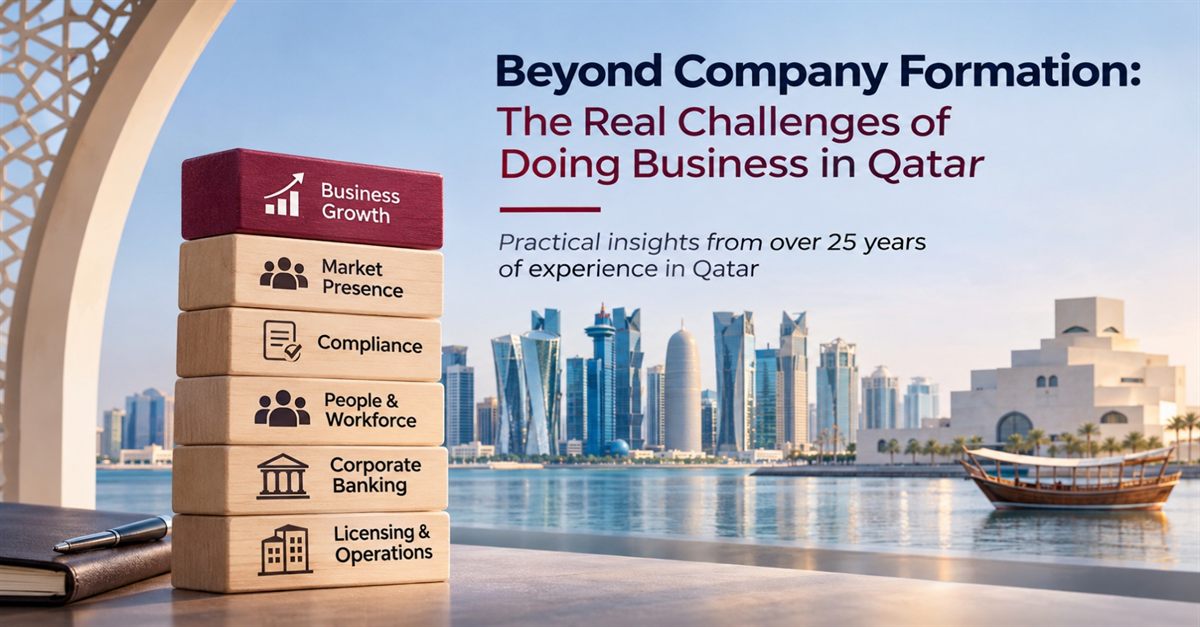
Beyond Company Formation: The Real Challenges of Doing Business in Qatar
By Anas Outa Bachi, Managing Director, Future Gate Business Services
Having spent more than 25 years working in Qatar's business environment, I have had the opportunity to witness the country's remarkable transformation and its development into one of the most attractive destinations for international investment in the region.
Throughout this journey, through my work at Future Gate Business Services, I have supported companies and investors from different parts of the world in establishing and developing their businesses in Qatar.
One observation has remained consistent over the years: establishing a company is often the easiest part of the journey. The real challenges begin after incorporation.
Many foreign investors arrive in Qatar with a clear business plan and the expectation that once their Commercial Registration (CR) is issued, they can immediately start operating. In reality, company formation is only the first step.
I would like to highlight some of the challenges that, in my experience, foreign companies should be prepared for.
1. From Registration to Actual Operations
Obtaining a Commercial Registration does not necessarily mean a company is ready to operate. Depending on its activities, further requirements may include a commercial license, premises approvals, municipality requirements, establishment cards, labor and immigration approvals, and other regulatory authorizations.
I have seen companies complete their incorporation without fully understanding these additional requirements, only to discover that commencing operations takes considerably more time and preparation than anticipated.
My advice is to understand the complete licensing and operational requirements before starting the incorporation process.
2. Corporate Banking
Opening a corporate bank account is one of the most underestimated challenges for newly established foreign companies.
Banks have their own compliance and due diligence procedures, which may involve reviewing shareholders, ultimate beneficial owners, source of funds, parent company activities, and the proposed business model.
Even when a company is properly registered, banking approval is not automatic.
Without an operational bank account, receiving payments, paying suppliers, managing salaries, and conducting normal business activities can become difficult.
This is something investors should address early, rather than waiting until the company has been established.
3. Immigration and Workforce Management
Another challenge begins when companies start recruiting.
Investors sometimes assume that obtaining a company registration automatically allows them to recruit employees without further procedures.
In practice, workforce requirements, labor approvals, immigration procedures, visa eligibility, job titles, and company activities all need to be considered.
Beyond recruitment, employers must understand their responsibilities under Qatar's Labor Law, including employment contracts, salary payments, leave entitlements, end-of-service benefits, and applicable health insurance requirements.
Managing employees in Qatar requires proper HR administration and continuous attention to regulatory compliance.
4. Compliance Does Not End After Incorporation
This is perhaps one of the areas where I see the greatest need for awareness.
Maintaining a company in Qatar involves continuous responsibilities. Commercial registrations and licenses need to be renewed, corporate information must remain accurate, and changes in ownership, management, or activities may require additional procedures and approvals.
Companies must also understand their tax registration, filing, accounting, audit, and other regulatory obligations.
For multinational groups, international developments such as OECD Pillar Two introduce additional considerations where applicable.
A company should have a proper compliance calendar and someone responsible for monitoring its obligations. Waiting until a renewal deadline or inspection to discover a problem can be costly.
5. The Right Premises and Location
Choosing an office is not simply a real estate decision.
The premises must be suitable for the company's registered activities and satisfy the relevant regulatory requirements. I have seen businesses commit to rental agreements and office fit-outs before confirming whether the premises are suitable for their intended activities.
My recommendation is to verify the licensing and approval requirements before signing a lease or making a significant financial commitment.
6. Understanding the Real Cost of Operating
Many investors focus on incorporation costs but do not adequately calculate the expenses of maintaining a company.
Office rent, employee salaries, license renewals, immigration expenses, accounting, auditing, insurance, banking, and administration can create a considerable financial commitment.
I always encourage investors to prepare a realistic operating budget covering at least their first 12 to 24 months.
Entering a new market requires financial patience. Companies should be prepared to support their operations while building their customer base and generating revenue.
My Advice to Foreign Investors
After more than 25 years in this market, I have come to believe that successful business establishment depends on preparation, realistic expectations, and having the right local support.
If I were advising an international company entering Qatar today, I would emphasize five things:
- Do not focus only on obtaining the Commercial Registration; understand the entire operational process.
- Plan your banking arrangements early.
- Understand your immigration, labor, and HR responsibilities.
- Establish a proper system for ongoing corporate and regulatory compliance.
- Work with experienced local professionals who understand the practical realities of operating in Qatar.
Through Future Gate Business Services, we have learned that companies need much more than assistance with incorporation. They need continuous guidance and support throughout their business lifecycle.
Looking Ahead
I remain very optimistic about Qatar's future as an international business destination. The country's economic development, infrastructure, regulatory improvements, and commitment to attracting foreign investment continue to create opportunities for international companies.
However, I believe there is still room to improve the post-establishment experience for investors, particularly through better coordination between authorities, more integrated government services, and clearer guidance on ongoing operational requirements.
My message to foreign investors is simple: do not measure your success in Qatar by how quickly you obtain your Commercial Registration. Measure it by how successfully you establish, operate, and grow your business.
Anas Outa Bachi
Managing Director
Future Gate Business Services, Qatar